Views: 0 Author: Site Editor Publish Time: 2026-11-28 Origin: Site


Selecting the right Cable Drum is not merely an afterthought in packaging. It forms a critical logistics and asset protection strategy for modern infrastructure. Incorrect selection leads to irreversible conductor damage. It causes inflated freight costs and triggers onsite handling failures. Procurement teams and project engineers face a constant challenge daily. They must balance strict technical specifications against complex price considerations. You need optimal bending radius protection alongside high container packing efficiency. Extending material lifespan while controlling costs is crucial for protecting project margins. We will establish a rigid evaluation framework for selecting your spooling equipment. You will learn how to assess material performance and precise dimensional specifications. We will match these metrics directly to your specific industry applications. By the end, you will understand how to optimize your shipping processes effectively and safeguard your valuable electrical assets from factory to installation.
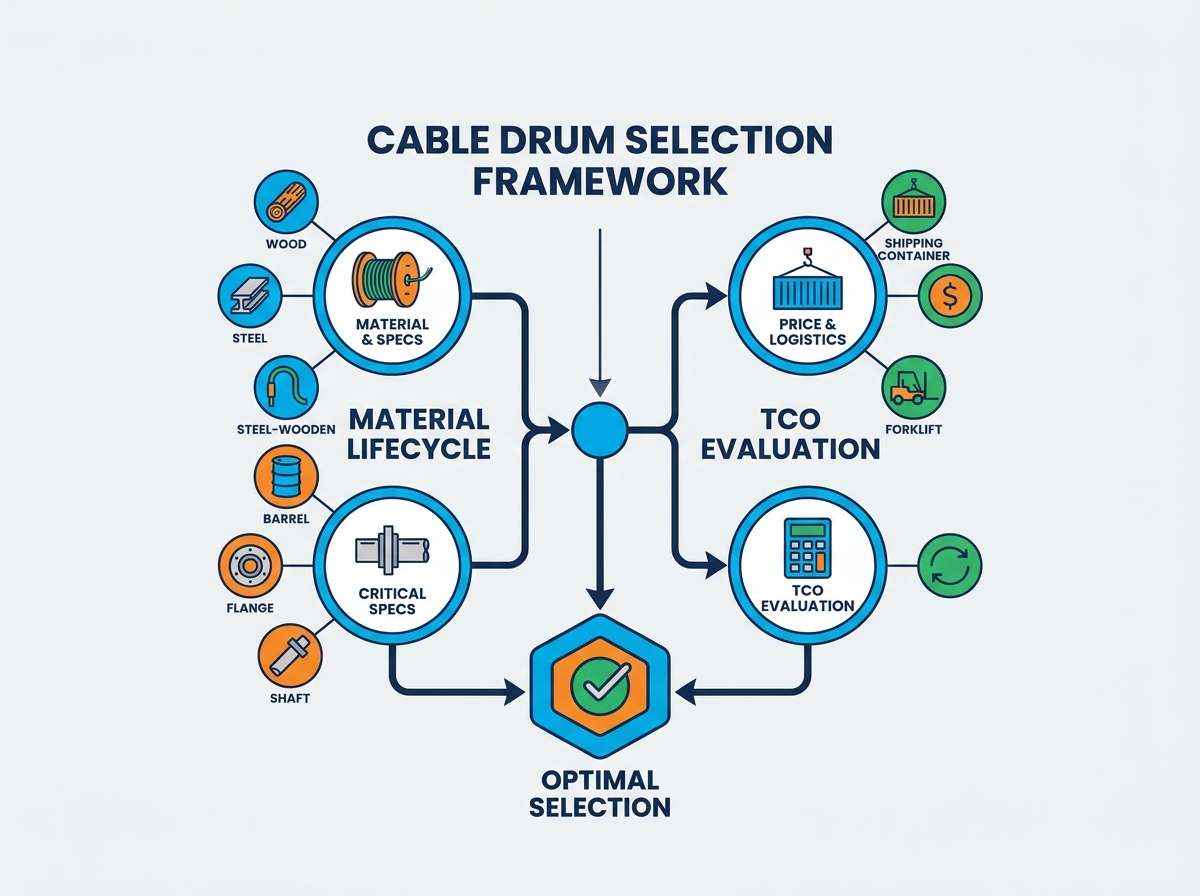
Material dictates lifecycle: Wooden drums offer cost-effective one-way transit, while steel and steel-wooden hybrids are capital assets suited for high-load, multi-trip operations.
Geometry protects the asset: Flange size and barrel diameter must strictly align with the cable’s Minimum Bending Radius (MBR) to prevent jacket stress and conductor damage.
Overall cost exceeds unit price: True cost evaluations must factor in tare weight, container packing efficiency, and return logistics.
Handling compatibility is non-negotiable: Shaft hole dimensions and structural integrity must match the end-user’s lifting and unspooling equipment.
You must align your material choice carefully. Consider project duration, environmental exposure, and return-logistics feasibility. Different materials serve entirely different logistical purposes.
Wooden models offer the lowest upfront cost. Manufacturers customize them easily for various dimensions. They remain the standard choice for commercial building projects globally. Builders appreciate their simple handling and wide availability. However, they carry specific environmental risks. Wood remains highly susceptible to rot over time. Moisture degradation weakens the structural integrity quickly. These units also have much lower overall load-bearing limits. A heavy load can crush a damp wooden flange easily. For international shipping, you must verify ISPM 15 certification. This global regulation requires strict heat treatment. It prevents the spread of invasive insects. Failing this compliance check causes severe customs delays. Border agents will quarantine or destroy uncertified shipments immediately.
Steel variants provide maximum structural integrity. Large corrugated structural designs handle massive weights safely. They are ideal for heavy Medium Voltage (MV) and High Voltage (HV) power lines. Utility companies rely heavily on these robust structures. They also offer excellent weather resistance against rain and snow. Galvanized coatings prevent rust formation during long-term outdoor storage. On the downside, they require a very high initial capital expenditure. Buying full steel fleets strains procurement budgets heavily. They also introduce significant return-freight costs due to their heavy tare weight. Shipping empty steel units back across the country gets expensive. Therefore, a steel Cable Drum is best viewed as a long-term capital asset. You must track and maintain them properly.
Hybrids combine the best traits of both materials. They feature the load-bearing strength of steel flanges and shafts. They utilize lighter, lower-cost wooden barrels internally. This smart approach saves money upfront during manufacturing. It also reduces the overall shipping weight significantly. Less weight equals cheaper freight bills. Hybrids are excellent for medium-duty applications. They suit repeated domestic use perfectly. You can replace the wooden barrel when it wears out. You keep reusing the durable steel flanges. This modular repairability extends the product lifecycle greatly.
You must calculate capacity accurately before purchasing. Ensure equipment compatibility without over-specifying the unit unnecessarily. Over-specifying drives up shipping and material expenses.
The central barrel must exceed the calculated MBR of your wire. This prevents dangerous micro-cracking in the delicate insulation. When micro-cracking occurs, moisture penetrates the internal layers. This moisture causes partial electrical discharge. Eventually, the entire circuit fails catastrophically. Different insulation materials require completely different handling approaches. For example, XLPE insulation is quite rigid. It demands a much larger bending radius than highly flexible PVC. You must consult the manufacturer specifications before finalizing the barrel size.
Below is a quick reference guide for MBR calculations.
Standard Minimum Bending Radius Multipliers
Insulation Type | Voltage Class | MBR Multiplier (x Outer Diameter) |
|---|---|---|
PVC | Low Voltage | 8 to 10 |
XLPE | Medium Voltage | 12 to 15 |
XLPE (Lead Sheathed) | High Voltage | 15 to 20 |
Rubber (EPR) | Flexible Mining | 6 to 8 |
Flanges must accommodate the total wire length easily. They also need an adequate clearance margin. Engineers call this safety margin "freeboard." This empty space protects the outer wire layers during manual rolling. If the wire sits flush against the edge, rough ground will crush it. Shafts present another crucial onsite checkpoint. The arbor hole size must be universally compatible. It needs to fit standard onsite jacks perfectly. Mismatched holes create severe unspooling bottlenecks. If the hole is too small, your payout stand spindle will not fit. Workers will waste hours attempting dangerous workarounds. A standardized Cable Drum arbor hole eliminates these costly field delays entirely.
Understand the strict relationship between tare weight and gross weight. The tare weight represents the empty structure itself. Gross weight includes the fully loaded product ready for transport. Specifying an oversized unit carries multiple hidden dangers. A fully loaded spool might easily exceed local road weight limits. Highway patrols issue massive fines for overweight axles. Furthermore, heavy spools could surpass your site crane lifting capacities. Always verify your onsite lifting equipment limits beforehand. Match these limits against the calculated gross weight carefully.
Contextualize your specifications based on sector-specific deployment challenges. Different environments demand radically different protective measures. A standard commercial spool will fail instantly in harsh industrial zones.
Mining & Heavy Infrastructure: These subterranean sites pose high abrasion and impact risks. They require heavy-duty steel construction exclusively. You will need reinforced flanges to survive accidental impacts. Heavy anti-corrosion coatings are mandatory. They protect against highly acidic underground water.
Marine & Offshore: Saltwater exposure accelerates metal degradation rapidly. Offshore oil rigs and wind platforms demand specialized protective treatments. You might even specify exact alloy constructs for extreme maritime environments. Standard galvanization often degrades under constant sea spray.
Renewable Energy (Wind/Solar): Solar and wind farms span incredibly rough terrain. Access roads are often temporary and uneven. These projects require exceptionally large corrugated structural variants. These robust designs handle long continuous runs of MV lines safely. They resist twisting forces during transport over bumpy dirt roads.
Telecommunications (Fiber Optics): Fiber optic lines carry much lighter loads. However, they are incredibly sensitive to lateral pressure. They require perfectly smooth barrel surfaces unconditionally. Highly rigid flanges are necessary to prevent fiber attenuation. Even slight bending causes signal loss across the glass strands.
You must move beyond simple unit prices. Calculate the true logistical and lifecycle expenses carefully. Many procurement managers ignore hidden transport fees.
Drum width and flange diameter impact container utilization directly. You must optimize for standard 20-foot or 40-foot shipping containers. Improperly sized units waste valuable floor space. Just a few extra inches of flange can ruin a loading plan. You might drop from fitting four spools across to only two. Shipping "dead air" creates a massive cost penalty. You pay full price for empty container space. Ask your supplier for exact shipping profiles. They can adjust dimensions slightly to maximize container density.
Consider two distinct financial models for your operational planning.
One-Way Model: Cheaper wooden options work best here. They are optimal when return shipping exceeds the cost of purchasing new units. Remote international projects usually favor this one-way approach.
Closed-Loop Model: Steel variants offer superior long-term financial value. They work incredibly well if your vendor operates an efficient recovery network. Refurbishment programs make high-quality steel highly economical over several years. You pay a higher initial price but avoid constant repurchasing.
Do not ignore end-of-life expenses in your calculations. Wooden units often incur strict disposal fees at project completion. Landfills charge premium rates for treating industrial wood waste. Conversely, steel units provide significant scrap value recovery. You can sell severely damaged steel to local recycling facilities. This scrap value recoups a portion of your initial capital expenditure.
Establish strict criteria for shortlisting manufacturing partners. You want to ensure product reliability and minimize transit risks. A poor manufacturing process jeopardizes your entire electrical installation.
Prioritize vendors offering verified delivery records. Ask them for past project logs. Request actual load-testing certifications instead of trusting theoretical spec sheets. A reliable manufacturer will proudly share real-world performance data. Ask for references from similar industrial sectors. Verify their claims regarding weather resistance and structural longevity.
Implement rigorous inspection routines upon delivery. For wood, inspect all surfaces for protruding nails or splinters. These tiny defects can easily snag and tear sensitive exterior jackets. A torn jacket ruins the waterproof rating entirely. For steel, examine the weld seams closely. Poorly executed welds fail suddenly under dynamic stress. Demand dynamic load testing verification before accepting bulk shipments. Dynamic testing simulates the harsh bouncing forces experienced during highway transit.
Take concrete steps before issuing any formal Purchase Order. First, request a detailed dimensional drawing for final approval. Second, secure an itemized quote detailing exact freight charges to your site. Finally, demand comprehensive material test reports. These reports prove the steel grade or wood treatment quality. This multi-step verification prevents costly logistical surprises later.
Selecting an optimal Cable Drum requires meticulous and synchronized planning. You must align bending radius needs against strict logistical weight limits. Carefully weigh all material lifecycle expenses before committing. Follow these vital next steps for success:
Map your entire delivery journey from the factory floor to final site unspooling.
Avoid defaulting to the lowest unit price without checking comprehensive freight dimensions.
Verify your onsite lifting equipment capacities to prevent dangerous handling bottlenecks.
Audit your chosen vendors for quality assurance certifications.
Under-specifying your packaging risks the absolute integrity of high-value electrical assets. Protect your major investments by treating your spools as critical engineering components.
A: Capacity relies on the barrel diameter, flange diameter, and inside width. You use standard volumetric formulas against the product's outer diameter. Always account for specific packing factors. Manufacturers provide capacity charts to simplify this mathematical process.
A: Industry standards typically recommend a minimum clearance of 50mm to 100mm. This space sits between the top layer of wire and the outer edge of the flange. Adequate freeboard prevents severe crushing damage during ground rolling.
A: Yes, provided they strictly comply with ISPM 15 regulations. They must be manufactured from properly treated wood. They also need to bear the corresponding physical stamp. This proves they underwent necessary heat treatment or fumigation.
A: They are highly recommended for ultra-heavy loads. You need them specifically for Medium Voltage and High Voltage power lines. In these scenarios, structural failure of standard units poses severe safety risks and catastrophic financial losses.