Views: 0 Author: Site Editor Publish Time: 2026-10-31 Origin: Site


Procurement professionals and material handlers frequently face an immediate point of confusion. The terms "magnetic lifter" and "lifting magnet" often appear interchangeably across the industry. This semantic blending creates serious specification errors on the shop floor. We must clarify the practical distinction. A "magnetic lifter" typically implies a compact, manually actuated permanent magnet used for localized workstation tasks. Conversely, a "lifting magnet" serves as a broader umbrella term. It encompasses large-scale, automated electromagnetic or electro-permanent systems dominating heavy manufacturing and steel yards. We need to move past simple vocabulary differences. This article evaluates the underlying technologies driving these tools. You will learn to assess real-world holding values instead of relying on theoretical limits. Ultimately, you will identify the exact magnetic lifting system aligning perfectly with your operational safety protocols, load parameters, and specific facility infrastructure.
Terminology: "Magnetic lifters" usually denote manual permanent units; "lifting magnets" cover the entire category, including powered heavy-duty systems.
Technology Choice: Selection depends on load volume, duty cycle, and power availability (Permanent vs. Electromagnetic vs. Electro-Permanent).
Performance Variables: Advertised capacity is based on ideal conditions; real-world "holding value" requires calculating for air gaps, material thickness, and surface roughness.
Risk Mitigation: High-quality units are defined by certified safety factors (typically 3:1 or 3.5:1 tear-off force) and verifiable testing documentation, not just aesthetic build quality.
The manual magnetic lifter operates without external power sources. These devices rely entirely on high-energy rare-earth materials, most commonly Neodymium (NdFeB). Operators actuate them using a mechanical lever. Turning this lever aligns the internal magnetic fields, directing the magnetic flux downward into the load. Reversing the lever short-circuits the field internally, releasing the material.
These units excel in specific environments. They are ideal for CNC machine loading, plate steel handling in fabrication shops, and independent workstations. Because they require no electricity, they offer complete mobility across your facility.
Powered lifting magnets represent a massive step up in scale and complexity. These systems require electrical current either to generate the magnetic field continuously or to toggle it momentarily. They dominate heavy industrial applications.
You will see these robust systems moving multi-ton steel slabs, clearing scrap yards, and feeding automated robotic welding cells. They handle high-frequency, repetitive material movement where manual actuation would cause severe operator fatigue. They can span several meters in length and often integrate directly into overhead crane control systems.
Understanding this distinction matters deeply for procurement. Buying the wrong category introduces severe operational friction. Choosing a manual unit for a high-volume production line slows down throughput. Conversely, installing an electromagnet for simple workstation tasks overcomplicates your power infrastructure. You must evaluate power availability, operator training requirements, and safety compliance standards before writing a purchase order.
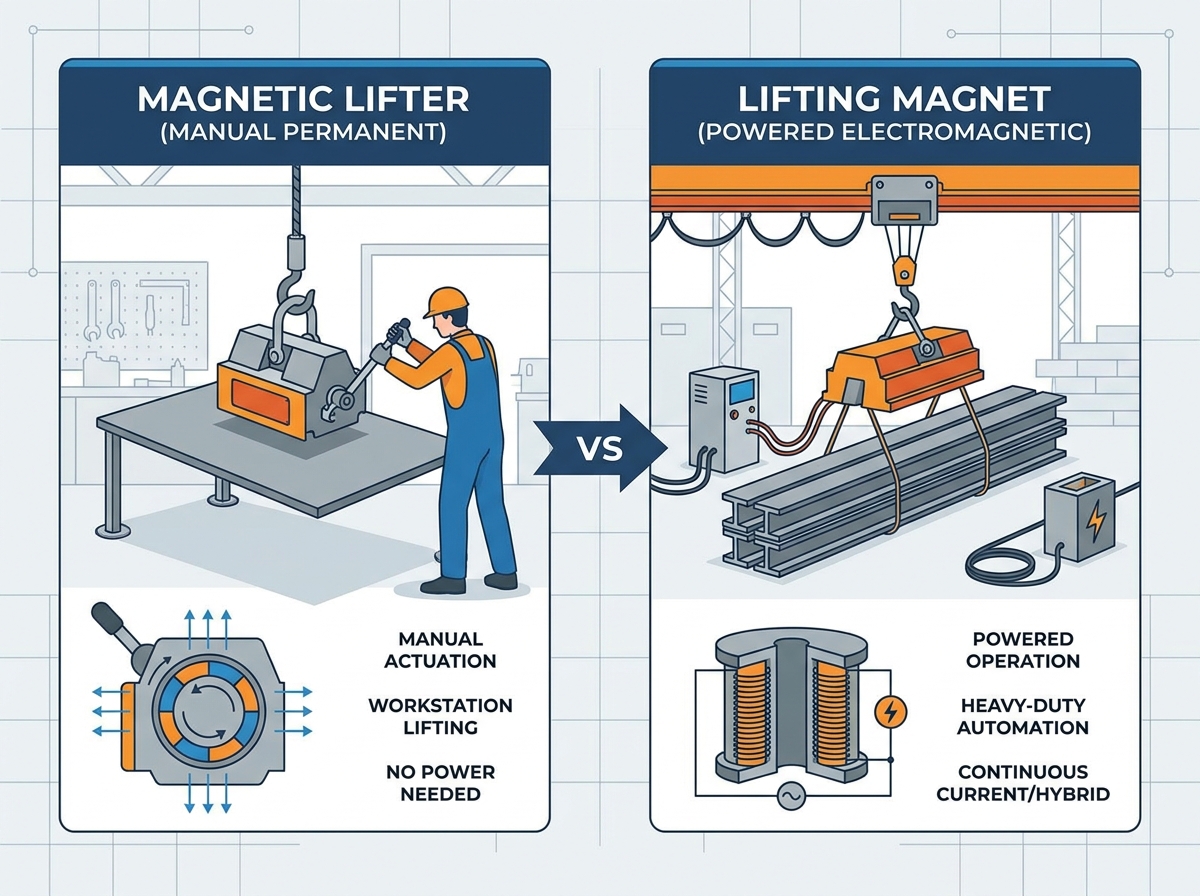
Permanent systems offer unmatched simplicity. Their greatest strength is a zero operational energy requirement. They are inherently safe during blackouts. A power outage will never cause a permanent magnet to drop a suspended load. They also provide excellent portability.
However, they have strict physical limitations. The maximum capacity is hard-capped by the size of the internal rare-earth magnets. High-repetition lines reveal another flaw: manual lever actuation quickly causes operator fatigue. Furthermore, they perform poorly on very thin materials. Thin steel lacks the mass necessary to saturate the magnetic field, resulting in weak holding forces.
Electromagnets use direct current passing through heavy copper or aluminum coils to generate powerful fields. They offer massive lifting capacities. They allow operators to vary the holding force, making it possible to drop single steel plates from a stack. They also penetrate deeply into rough or irregular materials.
Their limitations revolve entirely around electricity. They are 100% reliant on continuous power. If the facility loses power, an electromagnet instantly drops its load. This catastrophic risk makes expensive Battery Backup Systems (UPS) absolutely mandatory. Additionally, the coils generate significant heat during use. This heat buildup restricts them from running continuous, 24/7 duty cycles without cooling periods.
Electro-permanent magnets combine the best traits of both systems. They use a short pulse of electricity merely to toggle the magnetic state on or off. Once activated, permanent magnets hold the load securely. The system consumes no power during the actual lift. A power failure mid-lift will not result in a dropped load.
The primary limitations are financial and mechanical. They carry a much higher initial capital expenditure. They also house complex internal control circuitry. When repairs become necessary, you need specialized technicians rather than standard maintenance personnel.
Technology Type | Power Dependency | Drop Risk on Power Loss | Ideal Application |
|---|---|---|---|
Permanent Manual | None | Zero | Workstations, CNC loading |
Electromagnetic | Continuous | High (Requires UPS) | Scrap handling, thick slabs |
Electro-Permanent | Pulse Only | Zero | Automated cells, large plates |
Buyers often make dangerous assumptions based on manufacturer spec sheets. Vendors rate their maximum lift capacities under strictly ideal laboratory conditions. They test on thick, perfectly flat, low-carbon steel. The test blocks have zero surface rust, scale, or paint. Your shop floor rarely matches these pristine conditions. Expecting maximum advertised performance in the real world leads to dangerous failures.
Magnetic fields require physical mass to flow through. We call this magnetic saturation. If you place a large magnet on a thin sheet of steel, the field lines pass completely through the material and escape into the air below. The material cannot absorb the entire magnetic force. This lack of mass significantly reduces your actual safe working load. A unit rated for 1,000 kg might only safely hold 200 kg if the steel plate is too thin.
Any barrier separating the magnet from the raw steel acts as an air gap. This includes mill scale, rust, thick paint layers, or uneven surface textures. Magnetic force drops exponentially as the air gap increases. Even a half-millimeter layer of industrial paint can cut the holding value by half. You must account for these surface conditions before approving a lift.
Not all steel is highly magnetic. Low-carbon mild steel provides excellent magnetic pathways. Conversely, high-carbon steel, cast iron, and specific steel alloys resist magnetic flow. Cast iron contains structural voids and graphite flakes. Lifting cast iron components reduces your effective holding capacity by 30% to 50% compared to mild steel. You must identify your exact material alloys beforehand.
Smart buyers never purchase based on maximum advertised capacity. You must demand detailed derating charts from your vendors. These charts show the exact force reductions for specific thicknesses, air gaps, and materials. Audit your facility's primary load types. Cross-reference those exact dimensions against the derating chart to find the true safe working load.
Global standards dictate a 3:1 or 3.5:1 safety factor for lifting magnets. This means a unit rated for a 1,000 lb safe working load must require 3,000 lbs of physical force to tear it away from the test block. Budget manufacturers frequently manipulate these numbers. They achieve a 3:1 ratio in a sterile lab on polished blocks, but their units fail immediately on slightly rusty shop steel. Always verify how the safety factor was tested.
Cheap rare-earth magnets degrade rapidly. Low-quality Neodymium loses its gauss rating over time, especially when exposed to frequent temperature fluctuations. Budget units often lack proper housing insulation. Heat transfers easily into the magnet core, permanently weakening the magnetic force. A bargain unit might hold 1,000 lbs today but struggle to hold 600 lbs next year.
When evaluating a new magnetic lifter, focus on the mechanical handle. Internal machining tolerances dictate handle safety. Poor machining in cheap units causes the internal rotor to bind against the stator. This creates a sticky actuation process. Worse, sloppy tolerances can cause the lever to snap back violently, risking serious hand injuries to your operators.
Never accept generic batch testing documents. Rigorous safety standards, like ASME B30.20, demand strict individual testing. Every unit must arrive with a distinct testing certificate tied directly to its serial number. This document proves the exact tear-off force achieved by that specific piece of equipment. If a supplier cannot provide individual serial-number documentation, find another supplier.
Before bringing equipment on-site, analyze your infrastructure. Electromagnets demand heavy-duty cabling, specialized cable reels, and robust control panels. They also require mandatory battery backup systems. These electrical installations require professional contractors. Permanent lifters avoid this entirely. They act as immediate plug-and-play solutions. You simply attach them to your existing hoist hook and begin working.
Hardware is only half the safety equation. Operator behavior prevents accidents. You must establish strict facility protocols. Operators must test the load center-of-gravity by hovering the load a few inches off the floor before a full lift. They must physically clean the lifting surface, wiping away loose rust or debris. Most importantly, you must train everyone to stay entirely out of the defined "drop zone" during transport.
Different technologies require different maintenance routines.
Permanent Units: Require minimal upkeep. You must schedule an annual tear-off test to verify the safety factor remains intact. Operators should routinely inspect and lubricate the handle mechanism.
Powered Units: Demand rigorous electrical oversight. Maintenance teams must routinely inspect internal coils for heat degradation. They must check cable connections for fraying. Crucially, they must test the UPS battery health monthly to ensure fail-safe operation during a blackout.
Follow a structured path before finalizing any purchase orders.
Audit your typical load profiles. Document the minimum thickness, maximum weight, and surface conditions of your regular materials.
Assess your facility's power infrastructure. Determine if you can easily route heavy-duty power to your cranes.
Request on-site trials. Ask vendors to perform simulated tear-off tests using your actual materials, not their lab blocks.
The choice between manual and powered lifting systems requires moving past simple vocabulary. You must match the specific magnetic field behavior to your exact load realities. Never assume a flat spec sheet translates perfectly to a dirty shop floor. Credibility in material handling stems directly from prioritizing derated holding values over base prices. Demand certified safety documentation, analyze your material variables, and prioritize operator training to guarantee safe, efficient facility operations.
A: Yes, though very slowly under normal conditions. High-quality Neodymium magnets lose a fraction of a percent of their strength per decade. However, extreme heat exposure, severe physical impact, or damaged internal insulation can rapidly degrade the magnetic core. Regular annual testing is essential.
A: A safety factor indicates the built-in reserve capacity. A 3:1 safety factor means the magnet must require 3,000 lbs of physical force to tear away from a perfectly flat, thick steel test block in order to be rated for a 1,000 lb safe working load.
A: Yes. Many units feature a V-block design on the bottom face, allowing them to cradle round loads safely. However, lifting round materials significantly reduces surface contact. You must apply a severe capacity reduction—often 50% or more—when handling pipes or cylinders.
A: The load remains completely secure. Electro-permanent systems only use electrical power for a split second to switch the internal magnetic alignment. During the actual lift, they function entirely as permanent magnets, rendering them immune to sudden power failures.